
Indie Author Academy / Lessons
What indie author surveys reveal about selling books
What indie author surveys from Written Word Media and ALLi reveal about real income tiers, catalogue depth, email lists and weekly time budgets.
Indie author surveys paint a clear, unsentimental picture of self-publishing: most authors earn modest sums while they have only one to three books out, over 80% find marketing harder than writing, and higher monthly sales correlate far more strongly with catalogue depth and email list size than with viral social posts. Reading the survey patterns properly saves new authors from burning cash on premature ads and helps you invest your limited hours where returns actually compound.
Before setting targets for your own releases, it helps to separate headline anecdotes from broad industry data. Our breakdown of how much a self-published author makes explains why mean averages mislead compared with medians. Here we synthesise what recurring surveys from Written Word Media and the Alliance of Independent Authors show about selling books, and how to turn those findings into a practical weekly schedule.
How indie author surveys group real book earnings
Annual reports from Written Word Media divide self-published authors into four monthly gross revenue tiers that reflect distinct operational stages. Just Starting Out covers authors earning $500 or less per month. Building Momentum runs from $500 to $2,500 per month. Got Traction covers $2,500 to $10,000 per month, and Living the Dream starts at $10,000 or more per month.
Within that distribution, roughly 44% of respondents report earning $100 a month or less. Research published by the Alliance of Independent Authors and comparative income studies from The Authors Guild show a similar skew across publishing as a whole: a broad base of newer or part-time writers at low earnings, a middle tier building predictable side or full-time income, and a compact top tier generating six figures in gross annual sales.
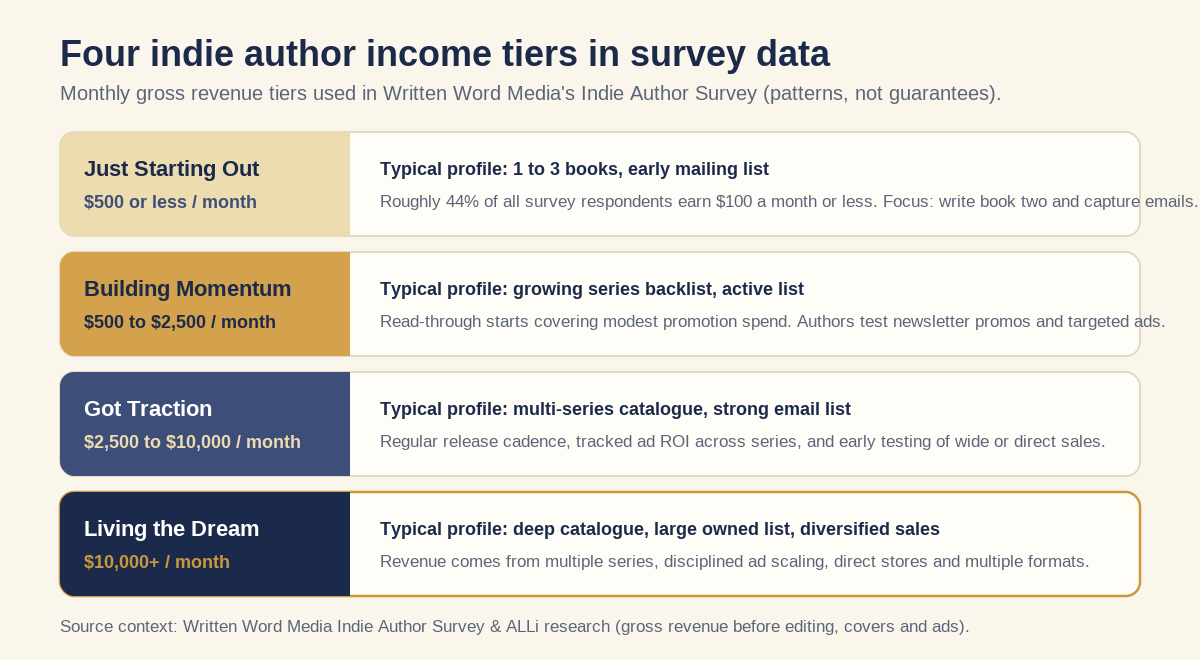
One detail matters before comparing yourself with any tier: these figures measure gross revenue, not take-home pay. Editing, cover design, ISBNs, mailing software and ongoing advertising all come off the top. An author in the Got Traction band spending heavily on pay-per-click ads can net less per month than a lean author in Building Momentum selling mainly to an owned mailing list.
Why one to three books rarely sustain full-time sales
Survey cross-tabs consistently show a steep climb in median monthly revenue as an author moves past three titles into a deeper backlist. The reason has nothing to do with mysterious platform favouritism; it comes down to acquisition arithmetic and reader retention.
When you publish one standalone novel, every reader who buys your book reaches a dead end on the final page. Even if they adore your writing, they have nothing else to purchase from you. To earn another sale tomorrow, you have to find a brand-new stranger, pay to reach them again, and persuade them to take a chance on an unfamiliar name.
Compare that with a four-book or six-book series in one clear subgenre. Each time you promote Book 1 through a price deal, a newsletter swap or a targeted advert, a portion of readers finish Book 1 and buy Book 2, Book 3 and Book 4 at full price without you paying a second penny in advertising. Your first book acts as the front door, while your sequels deliver the margin.
Why over 80% of authors name marketing as the hardest job
In Written Word Media's survey data, more than 80% of indie authors cite marketing as the hardest part of the business. That share stays stubbornly high even among experienced writers because book marketing asks for three skills that feel alien to solitary drafting: positioning a product for strangers, reading conversion data dispassionately, and repeating steady promotional habits long after launch excitement fades.
Many authors try to solve that discomfort by outsourcing everything too early or by scattering small bursts of effort across six tactics at once. One week they boost an Instagram reel, the next week they pay for an unvetted promotion package, and the week after they rewrite their blurb without waiting long enough to measure any change. Scattered activity creates exhaustion without generating reliable lessons.
If you are operating with minimal spare cash while writing your second and third books, follow a structured sequence rather than reacting to daily social trends. Our guide to marketing a self-published book with no budget maps out the highest-leverage free tasks first.
The two assets that correlate with higher monthly sales
Across both Written Word Media's surveys and ALLi's research on sustainable indie careers, two controllable variables stand out above every short-term tactic: catalogue depth and email list size. Higher-tier authors also diversify revenue more often through wide retail distribution, multiple formats and direct-to-reader shops once their reader base matures.
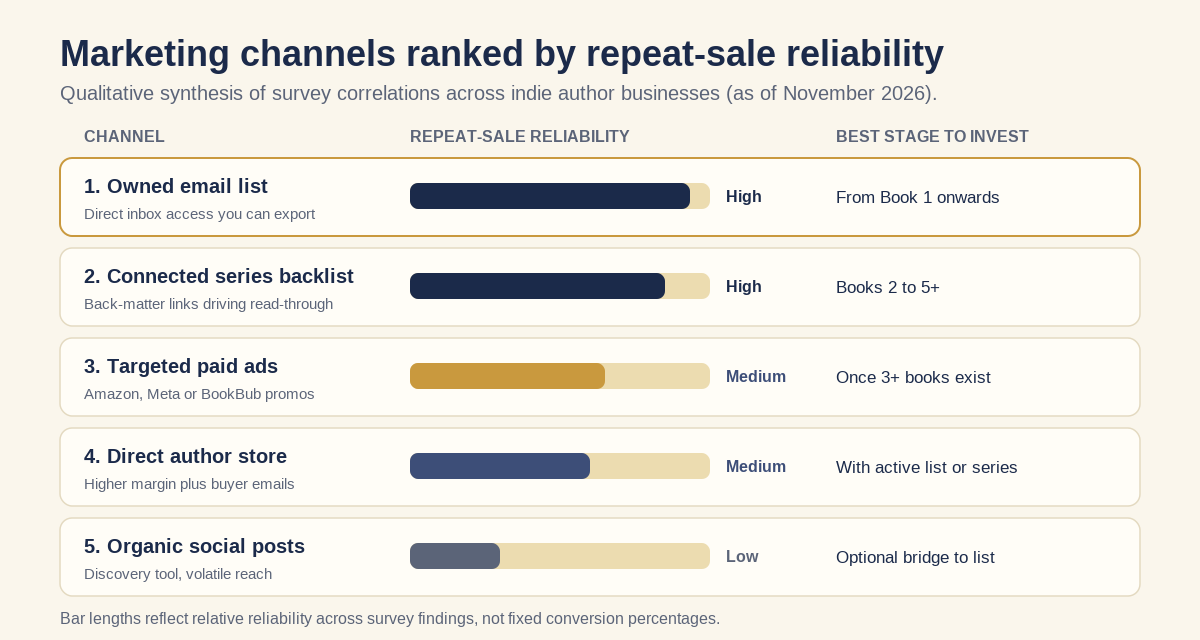
Notice where organic social media sits in that hierarchy. Social channels can spark occasional discovery, especially in trope-driven fiction genres, yet survey correlations show that raw follower numbers translate unreliably into recurring monthly revenue. By contrast, an email list grows steadily alongside every book you publish and responds predictably whenever you announce a new release or series bundle.
Deciding whether to stay exclusive in Amazon's KDP Select or distribute wide across Kobo, Apple Books and Barnes & Noble also shapes how your backlist earns. Our comparison of KDP Select versus going wide per book breaks down when each route fits a growing catalogue.
Worked example: read-through economics across one book versus four books
To make the catalogue effect concrete, compare two hypothetical authors running identical Book 1 promotions. As of November 2026, Amazon KDP's royalty terms pay 70% minus delivery fees on qualifying ebooks within the 70% pricing band (which runs from $2.99 to $12.99 in the US store and equivalent bands in UK/EU markets). For a clean worked example, assume an ebook nets £3.00 per full-price sale and £0.70 during a 99p Book 1 price promotion, and assume you spend £100 on a newsletter promotion that sells 100 copies of Book 1 at 99p.
Treat the figures in the table below strictly as an illustrative worked example, never as a promised return. Real read-through depends heavily on story pacing, editing quality, cover alignment and pricing.
| Metric (worked example) | Author A: 1 standalone book | Author B: 4-book series (60% read-through per book) |
|---|---|---|
| Promotion spend | £100.00 | £100.00 |
| Book 1 promo sales (100 copies at £0.70 net) | £70.00 | £70.00 |
| Book 2 sales (60 copies at £3.00 net) | £0.00 | £180.00 |
| Book 3 sales (36 copies at £3.00 net) | £0.00 | £108.00 |
| Book 4 sales (22 copies at £3.00 net) | £0.00 | £66.00 |
| Total gross royalty from the £100 promo | £70.00 | £424.00 |
| Net profit or loss after £100 spend | -£30.00 loss | +£324.00 net gain |
Both authors ran the exact same £100 campaign and sold the exact same 100 copies of Book 1. Author A lost £30 and concluded that paid marketing does not work. Author B cleared £324 above ad spend because three sequels existed behind Book 1. That arithmetic explains why survey earners with larger catalogues can afford continuous paid advertising while single-book authors struggle to break even.
You can model exact per-book margins before planning promotions using our KDP royalty calculator, and test how discounts interact with box sets in our series pricing and bundles guide.
How to split limited weekly hours based on the survey findings
Most indie authors write alongside jobs, family responsibilities or freelance work. Survey findings only become useful when they change what sits on your calendar next Tuesday evening. Rather than dividing your week evenly across every marketing idea you hear on podcasts, weight your hours according to your current catalogue size.
| Catalogue stage | Drafting and production | Email list and back-matter | Discovery and paid promos |
|---|---|---|---|
| 1 to 2 published books | 70% of weekly hours | 20% of weekly hours | 10% of weekly hours |
| 3 to 5 published books | 60% of weekly hours | 20% of weekly hours | 20% of weekly hours |
| 6 or more connected books | 50% of weekly hours | 20% of weekly hours | 30% of weekly hours |
At one or two books, spending 30% of your week tweaking ad bids starves the very asset that fixes your unit economics: Book 3. Once three connected titles are live, shifting a fifth of your time towards measured promotions and list growth starts paying back across multiple titles. Pair that schedule with a single monthly review sheet using our book sales and ROI tracking guide so you adjust based on your own figures instead of guesswork.
Notice that email list work stays fixed at 20% across every stage. On a ten-hour weekly schedule, two hours covers writing one concise reader email, updating a back-matter link when a new title releases, checking your signup page conversion rate, and welcoming new replies. Keeping that habit steady from Book 1 prevents the common trap of finishing a trilogy with zero direct way to tell earlier buyers that Book 3 is live.
The same discipline applies to cash budgets. Rather than spending £300 testing pay-per-click ads on a lone debut paperback with thin print margins, reserve ad testing until you have a clear Book 1 ebook hook, clean genre packaging, and at least one full-price sequel ready to catch readers who finish the story.
Reading survey figures without falling for survivor bias
Every public survey carries sampling limits worth keeping in mind as of November 2026. Written Word Media's respondents skew towards authors who actively subscribe to marketing newsletters and invest in promotions, so casual hobbyists who upload one manuscript and never check their dashboard again are underrepresented. Conversely, ALLi's core income benchmarks often focus on self-publishing authors who dedicate substantial working time to their publishing business rather than occasional side writers.
Survivor bias also distorts social media discussions. Authors who hit an unusually lucky launch or scale rapidly to five figures post screenshots publicly, while the thousands who quietly abandon book two after disappointing first-month sales stay silent. Neither extreme tells you what your books will earn.
Use indie author surveys as a compass rather than a scoreboard. Let the data set three grounded rules for the next twelve months: keep writing connected books, capture reader emails inside every title from day one, and track net profit after costs rather than gross hype. Those three habits put you on the side of the curve where time works in your favour.
Questions, answered
What do indie author surveys say most self-published authors earn?
Broad indie author surveys consistently show a bottom-heavy income distribution. Across Written Word Media's Indie Author Survey respondents, roughly 44% report earning $100 a month or less, while smaller tiers earn $500 to $2,500, $2,500 to $10,000, or over $10,000 a month.
Why do one to three books rarely produce full-time income?
With only one to three books available, every pound spent acquiring a new reader has to be recovered on a single sale or a short sequel chain. Larger connected catalogues let authors earn read-through royalties across multiple titles from the same initial marketing effort.
What is the biggest challenge reported in indie author surveys?
More than 80% of respondents in Written Word Media's Indie Author Survey identify marketing as the hardest part of self-publishing. Most authors enjoy drafting and revising manuscripts far more than testing book positioning, running paid promotions, or maintaining email sequences.
Do indie author surveys report net profit or gross revenue?
Most headline survey brackets report gross monthly book revenue before deducting editing, cover design, software subscriptions and advertising spend. An author earning $3,000 a month in gross royalties who spends $1,800 on ads keeps $1,200 before tax and production amortisation.
Which marketing channels correlate most reliably with higher survey tiers?
Both Written Word Media and the Alliance of Independent Authors highlight catalogue depth and email list size as the strongest correlates with higher recurring revenue. Diversified sales routes, including wide retail distribution and direct-to-reader shops, appear more often among established earners.