
Indie Author Academy / Lessons
Indie author income streams beyond Amazon royalties
Indie author income streams beyond Amazon include direct ebooks, signed paperbacks, wide retail, audio, subscriptions and special editions, built in sequence.
Relying on a single store for all your book royalties leaves your writing business exposed to sudden algorithm shifts, ad-cost spikes and account holds. Working authors reduce that risk by stacking six practical indie author income streams onto the same manuscript: direct ebooks and bundles, signed paperbacks, wide retail distribution, audiobooks, reader subscriptions and special editions. You do not need to launch all six in week one, because each channel builds cleanly on the catalogue and mailing list you already own.
The core shift is treating a finished novel or nonfiction guide as intellectual property that can be packaged in multiple formats rather than a single Amazon listing. As of November 2026, direct digital checkouts let UK authors keep more than 90 percent of a typical sale after payment processing, while wide retail, audio and print reach readers who never shop on Kindle. The arithmetic below shows what each stream actually returns and the exact order to add them without burning out.
Why single-retailer dependence puts indie author income streams at risk
Amazon remains the largest ebook marketplace in English, and ignoring it makes little commercial sense for most debut writers. The trouble begins when 100 percent of your monthly royalties flow through one login, one set of search rankings and one set of terms of service. A dip in Kindle Unlimited page-read payouts, a rise in click costs on Amazon Ads or an automated account review can cut revenue overnight.
We break down the exact operational fallout of an account suspension in our guide on what you still own if Amazon closes your KDP account. Even without an account closure, single-store publishing caps your pricing flexibility. Under Amazon KDP royalty rules, the 70 percent ebook band applies between $2.99 and $9.99 (minus a file delivery fee), while books and multi-book box sets priced above $9.99 drop to the 35 percent band. Selling a three-book digital omnibus at £14.99 on your own site instead of dropping to 35 percent on a retailer changes your unit economics immediately.
Industry organisations such as the Alliance of Independent Authors consistently advise writers to hold onto subsidiary rights and diversify revenue as their backlist grows. Diversifying indie author income streams protects your cash flow, gives you buyer email addresses you can actually contact on launch day and lifts the lifetime value of every reader who finishes chapter one.
Six practical revenue streams built from one book or series
Every channel below can be fed from a single completed story or nonfiction title. Each one serves a different buyer habit and carries its own margin and workload.
1. Direct ebooks and digital series bundles
Selling EPUB files directly from your own website lets you capture full retail margin on individual titles and high-ticket series box sets. Because there is no 30 percent to 65 percent retailer cut, you keep the sale price minus payment processing and any flat monthly platform fee. Direct checkouts also give you immediate cash flow instead of waiting 60 days for retailer royalty disbursements, and you keep the customer relationship for future releases.
You can compare exact per-sale deductions in our breakdown of what you keep on a £4.99 ebook sold direct, or run your own retail price through the KDP versus direct royalty calculator.
2. Signed paperbacks and print-on-demand direct fulfilment
Many readers who discover you digitally still want a physical copy for their shelf or as a gift. You have two clean ways to sell print direct: order short author-copy runs to sign and post yourself, or connect your shop to a direct print-on-demand partner such as BookVault so orders print and ship automatically to buyers in the UK, US and beyond. Signed copies, bookplates and stamped collector editions command a higher retail price than standard Amazon paperbacks because readers value the personal touch. See our practical setup walkthrough on how to sell signed paperbacks direct from your website.
3. Wide retail ebooks, print and library lending
Going wide places your book on Apple Books, Kobo, Barnes & Noble, Smashwords and library networks such as OverDrive and BorrowBox. An aggregator such as Draft2Digital distributes one clean manuscript file to dozens of stores and library catalogues for roughly 10 percent of the retail price (leaving you around 60 percent on standard 70 percent storefronts), or you can upload directly to Kobo Writing Life and Apple Books to keep the full retailer royalty. Wide sales build slower than Amazon launches, yet they create steadier long-tail income in Canada, Australia, Europe and public libraries.
4. Audiobooks across retail and direct
Audio reaches commuters, runners and readers who prefer listening while cooking or walking the dog. Production requires upfront investment in a human narrator or a royalty-share agreement, so it makes the most financial sense once a book has proved it converts well in ebook and print. Choosing non-exclusive distribution allows you to appear on Audible, Apple Books, Spotify, Kobo and libraries while also selling downloadable MP3 or M4B editions straight from your own storefront. Read our full comparison of rights and platforms in audiobooks for indie authors: ACX, Findaway Voices and the rights you keep.
5. Reader subscriptions and paid memberships
Subscriptions turn irregular launch spikes into predictable monthly income. Authors run memberships on platforms such as Patreon, Ream or paid newsletter tiers, offering early access to chapters, deleted scenes, monthly short stories or behind-the-scenes writing notes. As of November 2026, Patreon pricing charges new creator pages published after 4 August 2025 a flat 10 percent platform fee on membership income and digital sales, plus payment processing fees, currency conversion on cross-currency pledges and Apple's iOS App Store commission of up to 30 percent on in-app sign-ups unless routed through web checkout. Memberships reward steady writers with an established readership, though they create ongoing delivery pressure if started too early.
6. Special editions, crowdfunding and foreign rights
Once you have a loyal mailing list, crowdfunding campaigns on Kickstarter or direct preorder runs for deluxe hardcovers can generate a major annual cash injection. Foiled dust jackets, sprayed edges, custom chapter illustrations and numbered slipcases appeal directly to collectors willing to pay £35 to £75 for a book they already love. Alongside collector print, proven backlist titles can earn extra income through foreign language editions; our guide to translating your book, rights, costs and stores covers when to license overseas rights versus funding a translation yourself.
Comparing net margin across all six channels
Headline royalty percentages rarely tell the whole story because delivery fees, printing costs and card processing bite differently at each price point. The chart and table below show worked examples using published UK rates as of November 2026, assuming domestic UK card payments and standard file sizes before advertising spend or income tax.
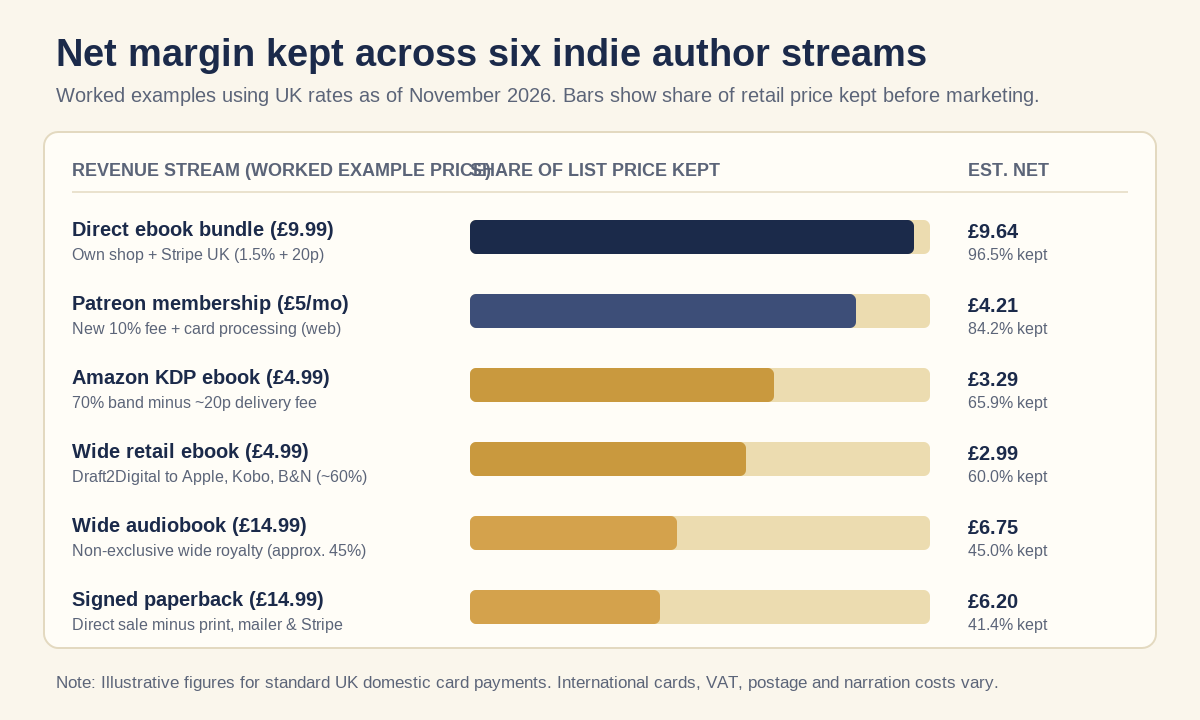
For direct digital sales in the UK, Stripe UK pricing charges 1.5 percent plus 20p on standard UK cards as of November 2026 (higher for international and commercial cards), with zero retail commission when you sell through your own platform. On a £9.99 three-book digital bundle, Stripe takes 35p, leaving £9.64 per order before your flat monthly website fee. Contrast that with a £9.99 box set on Amazon KDP (which loses 30 percent plus a larger megabyte delivery fee) or a £10.99 box set that falls into the 35 percent royalty band.
| Income stream (worked example) | Illustrative retail price | Main deductions (Nov 2026) | Estimated net kept | Share kept |
|---|---|---|---|---|
| Direct ebook bundle (own shop) | £9.99 | Stripe UK 1.5% + 20p (35p) | £9.64 | 96.5% |
| Reader membership (Patreon web) | £5.00 / month | 10% new fee + card processing (~79p) | £4.21 | 84.2% |
| Amazon KDP ebook (70% band) | £4.99 | 30% cut + ~20p delivery fee | £3.29 | 65.9% |
| Wide ebook via Draft2Digital | £4.99 | 30% store + ~10% distributor cut | £2.99 | 60.0% |
| Wide non-exclusive audiobook | £14.99 | Approx. 55% retail and distribution | £6.75 | 45.0% |
| Direct signed paperback | £14.99 | Print (~£4.20), mailer/post (~£4.17), Stripe (~42p) | £6.20 | 41.4% |
Notice the trade-off between percentage margin and built-in traffic. Direct bundles keep 96.5 percent of the cover price, yet you must bring the buyer from your mailing list, back matter or podcast appearances. Amazon and wide stores keep a larger cut because they put your book in front of browsing shoppers who have never heard your name. Healthy indie author income streams combine high-discovery retail stores at the front of your funnel with high-margin direct products for returning fans.
What a worked annual revenue mix looks like for a three-book series
To see how multi-channel publishing reduces risk in practice, consider a worked example of an indie novelist with a completed trilogy and an engaged mailing list of 1,500 readers. These figures are purely illustrative to show how modest monthly unit volumes add up across channels rather than a promise of earnings.
- Amazon KDP ebooks and paperbacks bring in 180 ebook sales a month across the trilogy at £3.29 average net plus 25 paperbacks at £2.80 net, totalling £662.20 a month or £7,946 a year.
- Direct ebook and trilogy bundle sales through the author's own shop average 35 bundles a month at £9.64 net, totalling £337.40 a month or £4,049 a year.
- Wide retail ebooks across Apple Books, Kobo, Barnes & Noble and libraries add 70 units a month at £2.99 average net, totalling £209.30 a month or £2,512 a year.
- Direct signed paperbacks sold to newsletter readers and at two local book fairs average 18 copies a month at £6.20 net, adding £111.60 a month or £1,339 a year.
- Wide audiobooks on the trilogy generate 45 monthly sales across Audible, Apple and libraries at £6.50 average net, adding £292.50 a month or £3,510 a year.
- One annual special-edition hardcover preorder run of 120 copies at £38 retail nets roughly £18 per copy after collector printing, packaging and fees, adding £2,160 for the year.
In this worked example, total annual net revenue reaches £21,516 before marketing spend and fixed software costs. Amazon accounts for 37 percent of the total rather than 100 percent. If Amazon ad costs climb for two months or a category rank dips, more than 60 percent of the author's income keeps arriving from direct bundles, wide stores, audiobooks and collector editions.
The right order to add income streams without burning out
The fastest way to stall a writing career is trying to open six storefronts, record an audiobook, design a Kickstarter and run a weekly Patreon tier before finishing book two. Sequencing protects your writing hours while building each new stream on top of assets that already exist.
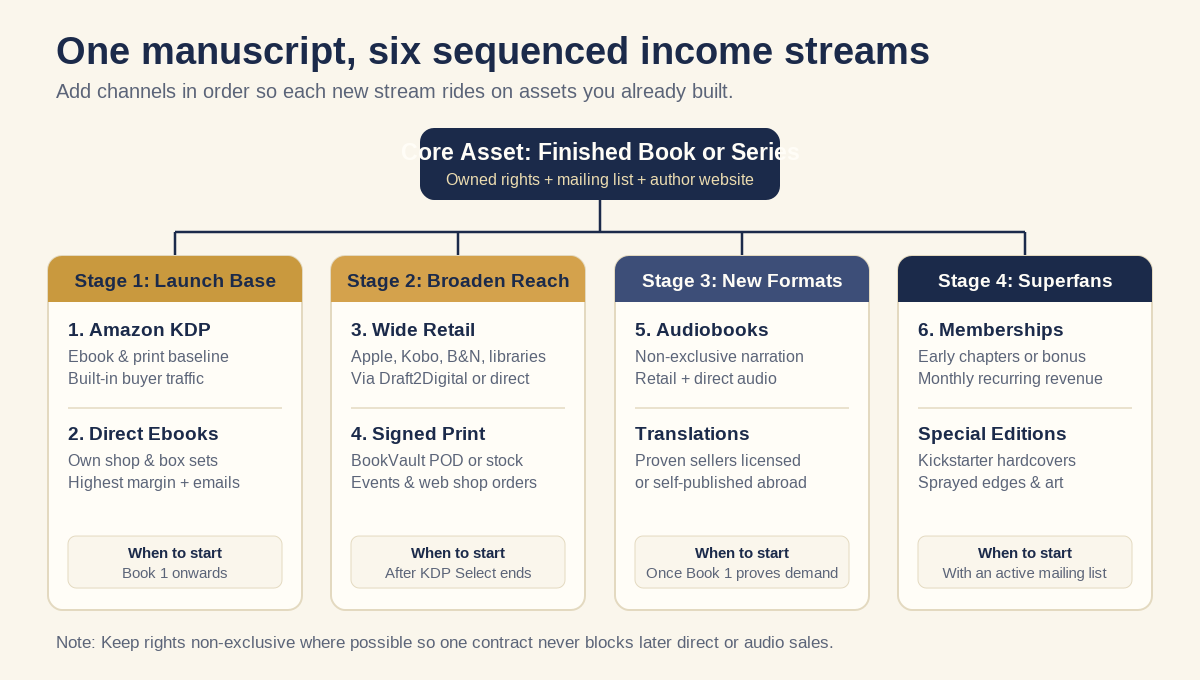
- Stage one (book one launch): publish your ebook and paperback on Amazon KDP, build a clean author website on your own domain and put a mailing-list signup link in the back matter of every edition. If you skip KDP Select, turn on a simple direct ebook page right away so readers from podcasts, social profiles or newsletters can buy straight from you.
- Stage two (after book one settles or KDP Select ends): upload your ebook to Apple Books, Kobo and wide stores via Draft2Digital or direct dashboards, and add signed paperbacks or direct print-on-demand fulfilment to your website shop.
- Stage three (once reader demand is proven across two or three books): invest profits into non-exclusive audiobook production for book one, then use early audio royalties to fund books two and three. Only evaluate translations after an English title shows steady multi-year demand.
- Stage four (with an active mailing list of 1,000 or more engaged readers): test a limited-run special-edition hardcover preorder or a light, sustainable reader membership that shares work you are already writing, such as early chapters.
Following this four-stage ladder keeps administration manageable. You finish your next book on schedule, and every new book lifts sales across every channel you have already opened.
What to check before leaving KDP Select for wide and direct sales
Many indie authors start inside KDP Select so their ebook appears in Kindle Unlimited. While your title is enrolled, you cannot sell the digital ebook on your own website or on Apple Books, Kobo or Barnes & Noble. Leaving Select requires a short checklist rather than an impulsive toggle.
First, check your current 90-day enrolment expiry date inside the KDP bookshelf and untick automatic renewal at least a few days before the period closes. Second, confirm that no promotional days or active ad campaigns rely exclusively on Kindle Unlimited page reads during the transition week. Third, prepare your clean EPUB file, cover image and book metadata so your direct shop page and wide retailer listings go live the morning after exclusivity expires. Our complete breakdown of KDP Select exclusivity and selling direct explains what remains allowed during enrolment, including paperbacks, hardcovers, audiobooks and limited sample chapters.
Remember also to keep your direct shop pricing aligned with retailer terms. Rather than undercutting Amazon by a few pence and risking a price-match headache, keep your single ebook price matched and give direct buyers extra value instead: an exclusive bonus epilogue, early release seven days ahead of retailers, or a discounted three-book bundle.
Managing admin, VAT and fulfilment as your channels grow
Adding channels introduces practical housekeeping that is easy to handle when set up cleanly from the start. Keep a single master spreadsheet tracking every ISBN, format, retailer login, pricing tier and royalty payment schedule so tax returns take an afternoon instead of a week. Store master files (final EPUB, print-ready interior PDF, cover wraps and audio WAV/MP3 masters) in one backed-up folder per title.
Check digital sales tax rules before selling direct internationally. As of November 2026, UK ebooks are zero-rated for VAT, meaning UK consumers pay no VAT on digital books, whereas direct digital sales to consumers in the EU trigger local VAT rules from the first order unless you sell through a merchant-of-record checkout or register under the EU One Stop Shop scheme. Printed books shipped into the EU also carry product-safety labelling rules under GPSR, which compliant print-on-demand partners handle on your behalf when configured properly.
Keep your software stack lean so fixed monthly subscriptions do not eat the margin you worked hard to gain. Hosting a separate website builder, email provider, file delivery tool and digital storefront can quickly pass £50 to £80 a month before you sell a single direct copy. If you want your author website, mailing list, direct ebook shop, ARC delivery and press kit under one roof, Indie Author Toolchest bundles them at $12.99 a month or $120 a year with a 14-day free trial (no card required), with direct sales switching on when you subscribe. You can also explore how direct digital delivery works on our sell ebooks direct overview page.
Pick the single next stage from the four-stage map above, set a date on your calendar to build it once your current draft is safely edited, and keep your core energy focused on writing the next book your readers want to buy.
Questions, answered
How many income streams should a debut indie author set up for book one?
Start with two streams on book one: Amazon KDP for built-in buyer discovery and your own author website with a mailing list and simple direct ebook option once you are outside KDP Select. Adding wide print, audiobooks and memberships before you have a steady readership spreads your time too thin and slows down book two.
Can I sell direct paperbacks and audiobooks while my ebook is in KDP Select?
Yes. KDP Select exclusivity applies only to the digital ebook edition enrolled in the 90-day term, so you remain free to sell paperbacks, hardcovers and audiobooks through your own website or wide distributors at the same time. Wait until your 90-day enrolment ends and auto-renew is switched off before listing the ebook itself elsewhere.
Which author revenue stream leaves the highest profit margin per copy?
Direct ebook sales and digital series bundles sold from your own website keep the highest percentage of the cover price, often above 90 percent after Stripe card processing. Signed paperbacks and Kickstarter special editions can bring higher pound profit per order, though printing, packaging and postage reduce the percentage margin.
Do I need a large backlist before launching a paid reader subscription?
You do not need twenty novels, though you do need predictable output and an engaged email list before charging monthly fees. Most working authors wait until they have at least a few hundred active email subscribers and a steady habit of publishing bonus scenes, early chapters or regular instalments without stalling their main books.
Are translation rights worth pursuing for a self-published author?
Translations work best once an English title has already proved strong reader demand and steady sales in its home genre. Upfront human translation costs can run into thousands of pounds per novel, so most authors either license foreign rights to an established overseas publisher or fund a German or Spanish edition only after the original book has paid for itself.