
Indie Author Academy / Lessons
Six habits that separate growing indie authors in 2026
Six operational habits shared by growing indie authors: connected backlists, book-linked email onboarding, ROI tracking, genre packaging and owned access.
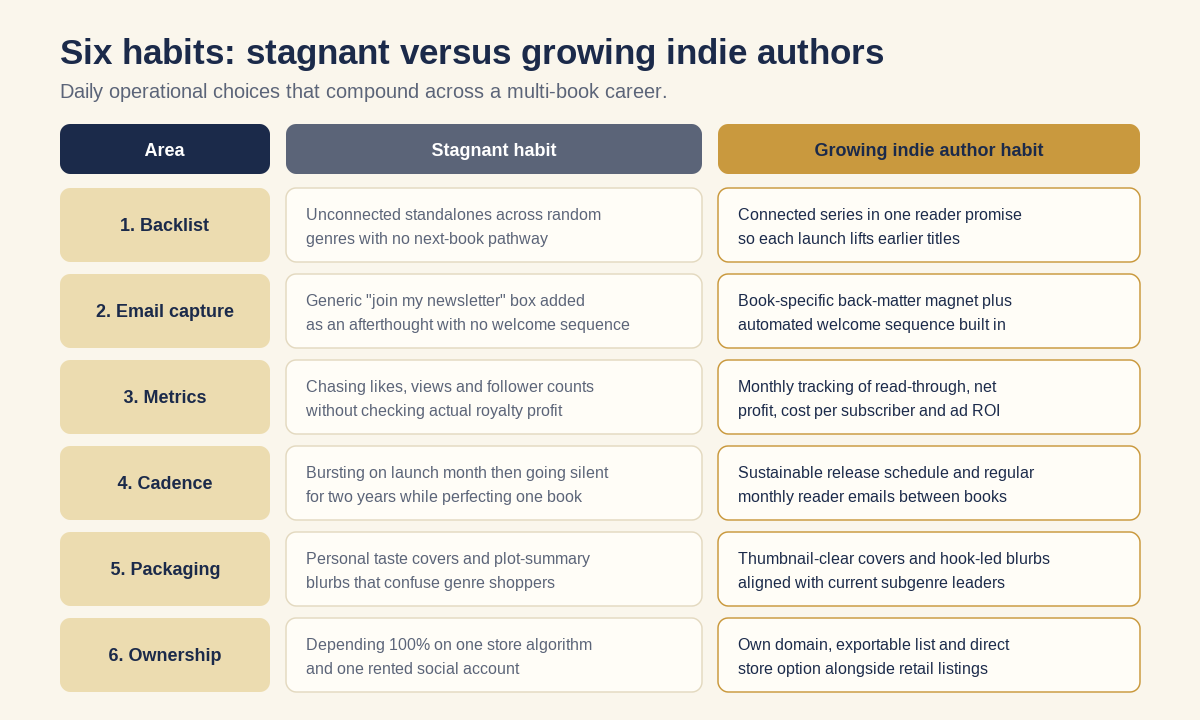
Growing indie authors rarely succeed because of a single viral video or lucky algorithmic push. Across industry surveys and working catalogues, steady growth comes from six repeatable operational habits: writing connected backlists, building email onboarding into every manuscript, tracking read-through and net profit instead of likes, keeping a sustainable release cadence, matching genre packaging conventions, and owning a direct reader channel early.
By contrast, catalogues tend to stagnate when an author treats each launch as an isolated sprint, jumps between unrelated genres, ignores back-matter links, and measures progress by social notifications rather than repeat buyers. Both Written Word Media's Indie Author Survey and guidance from the ALLi Self-Publishing Advice Center confirm that backlist depth and owned reader lists separate expanding indie businesses from stalled ones. Below are the six habits in practical detail, followed by worked backlist compounding maths and a 90-day reset plan.
Habit 1: growing indie authors write connected backlists
Stagnant catalogues often look like a patchwork quilt: a sci-fi novella published in year one, a personal memoir in year two, and a historical romance in year three. Each title forces the author to start from zero with a completely different audience. Readers who loved book one feel baffled by book two and drift away.
Growing indie authors design their releases so every finished book hands readers directly to the next one. That usually means a numbered series with a recurring cast, a shared world with interconnected standalones, or a clear non-fiction sequence solving adjacent problems for the same reader group. If you genuinely want to write in two incompatible genres, keep each audience cleanly separated under distinct pen names and mailing lists.
Connected backlists also unlock pricing tools that single books cannot use. Once three or four connected books exist, discounting Book 1 or bundling Books 1 to 3 pulls readers straight through the rest of your catalogue. Our guide to series pricing, bundles and box sets lays out how to price each step without eroding full-price sequels.
Habit 2: treat email onboarding as part of the manuscript
Many authors finish formatting their ebook, upload it to retailers, and only afterwards remember to slap a bland line reading "Sign up for my newsletter at my website" onto the final page. Very few readers type a naked web address into their phone browser just to receive occasional updates.
Growing indie authors treat reader capture as an integral closing chapter of the book itself. Right after the final sentence, on the very next page while emotional momentum peaks, they place two clean links: one direct link to the next book in the series, and one link offering a specific free bonus tied to the story, such as a deleted scene, prequel novella, epilogue, or companion guide.
Once a reader clicks through and joins, an automated welcome sequence takes over immediately. Those first few emails deliver the promised bonus, introduce your reading order, invite a reply so inbox providers recognise genuine human engagement, and point readers towards your backlist. If you have not built that automated sequence yet, follow our blueprint for the first six author newsletter emails and pair it with the list-building steps in getting your first 100 email subscribers.
Habit 3: track read-through and ROI instead of vanity likes
Social dashboards give instant dopamine: heart icons, comment counters, video views and follower badges. None of those figures pays an editor or covers a cover designer's invoice. Authors whose sales stall often spend hours checking impressions while never calculating whether last month's £120 promotion actually returned a profit.
Growing indie authors check a short, boring monthly ledger covering five numbers:
- Gross royalties by retailer and direct store for the past 30 days.
- Total marketing and software spend for the same period.
- Net operating profit after ad spend and recurring subscriptions.
- Series read-through percentage from Book 1 to Book 2, and from Book 2 to Book 3.
- Net new email subscribers added and cost per subscriber if paid traffic was used.
Tracking those five numbers once a month removes emotion from marketing decisions. If Book 1 sells 200 copies during a promotion and only 30 readers buy Book 2, you have a 15% read-through problem to diagnose in Book 1's ending or back-matter link rather than an excuse to spend more on adverts. Our template for tracking book sales and return on investment gives you a simple spreadsheet layout you can update in twenty minutes a month.
Habit 4: publish on a sustainable, repeatable cadence
Online publishing forums swing between two unhealthy extremes: authors trying to force out a 70,000-word novel every four weeks until they burn out, and perfectionists revising one manuscript for four years while publishing nothing. Both extremes interrupt momentum.
Growing indie authors pick a realistic publishing rhythm that fits their actual life and protect it fiercely. For a part-time writer with a day job, two well-crafted books a year is a strong, sustainable pace. Over three years, that quiet consistency builds a six-book backlist without wrecking your health or your editing standards.
Between releases, steady communication bridges the gap. Sending one concise, human email a month keeps your author name warm in readers' minds so launch day never feels like a cold pitch from a stranger who vanished for nine months.
Habit 5: package every title to match clear genre signals
Readers browse digital bookstores at high speed, often scrolling through twenty tiny cover thumbnails on a phone screen in ten seconds. Your cover, title typography and opening blurb hook exist to signal one thing instantly: "This book delivers the exact genre experience you are shopping for tonight."
Stagnant books often suffer from personal-taste packaging. An author commissions an artistic minimalist cover for a fast-paced thriller, or writes a 350-word plot synopsis explaining the backstory instead of the central stakes. When shoppers cannot identify the subgenre at thumbnail size, they keep scrolling, which pushes ad click-through rates down and raises acquisition costs.
Before commissioning cover art or finalising a product description, study the top twenty indie-published bestsellers in your exact subgenre as of November 2026. Note the colour palette, font weight, focal imagery and blurb structure. You want your book to look unmistakably at home on that shelf while still standing out through crisp professional execution. If an existing book gets clicks without sales, work through our troubleshooting guide on why a book is not selling before spending another pound on traffic.
Habit 6: own your direct reader channel before you need it
Relying entirely on a single retailer or a single social platform leaves your publishing income exposed to policy shifts, payment delays or sudden algorithm changes. Distributing widely through aggregators such as Draft2Digital expands retail reach beyond one store, yet even wide retailers do not hand you buyers' email addresses.
Growing indie authors build their own hub early: a clean website on a domain they control, an exportable subscriber list, and the ability to sell ebooks or special editions direct once their readership grows. Having your own storefront and reader delivery setup means higher per-sale margins and direct customer relationships that survive any store shake-up.
You do not need an expensive custom-coded web agency to start. Review what a lean site requires on our author website builder page, or look at how the Indie Author Toolchest combines an author website, mailing list, ARC distribution and direct ebook sales (which switch on when you subscribe) at $12.99 a month or $120 a year after a 14-day free trial with no card required.
Worked example: how five connected releases compound monthly sales
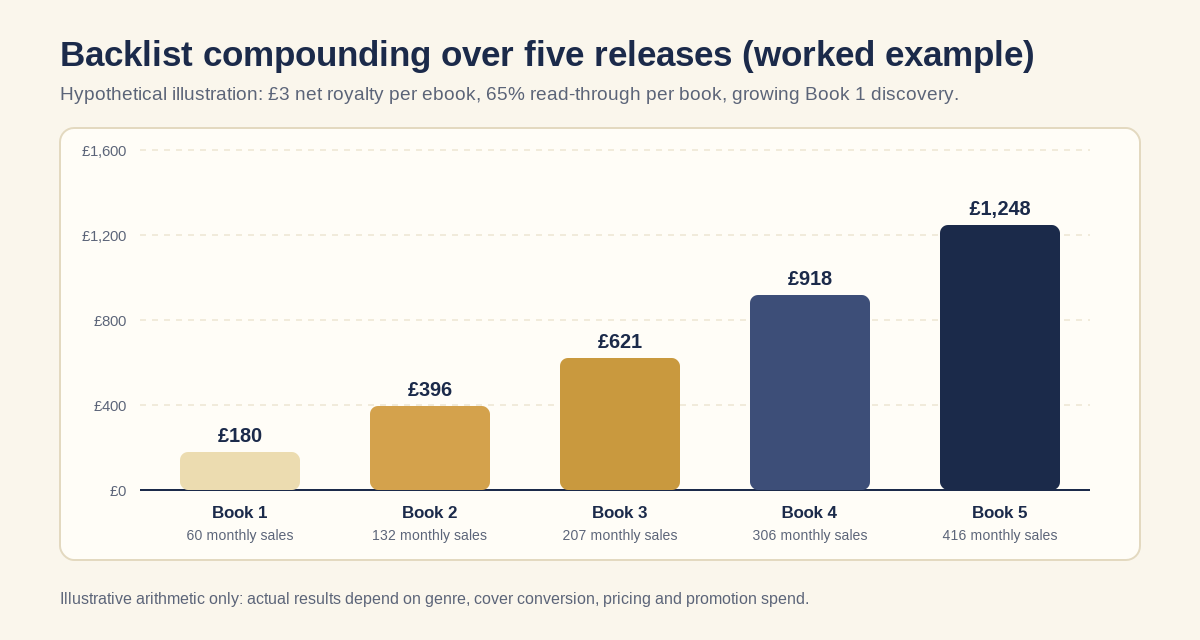
To illustrate why Habits 1 through 6 reinforce one another, consider a worked example of a five-book connected series. Every figure below is strictly hypothetical arithmetic to demonstrate compounding mechanics, never an earnings promise.
Suppose each ebook nets £3.00 in royalty per copy. Suppose 65% of buyers who read Book 1 go on to buy Book 2, and 65% of each book's readers continue to the next volume. Suppose also that as each new release triggers newsletter announcements, series visibility and cross-links, monthly Book 1 discovery rises gradually from 60 copies at Book 1 to 165 copies by Book 5.
| Catalogue milestone (worked example) | Monthly Book 1 sales | Total monthly series copies sold | Monthly net royalty at £3.00/copy |
|---|---|---|---|
| Book 1 live | 60 | 60 | £180 |
| Books 1 to 2 live | 80 | 132 (80 + 52) | £396 |
| Books 1 to 3 live | 100 | 207 (100 + 65 + 42) | £621 |
| Books 1 to 4 live | 130 | 306 (130 + 85 + 55 + 36) | £918 |
| Books 1 to 5 live | 165 | 416 (165 + 107 + 70 + 45 + 29) | £1,248 |
Notice the leverage in row five: Book 1 sales less than tripled (from 60 to 165 copies a month), yet total monthly royalties multiplied nearly sevenfold (from £180 to £1,248). Every hour invested in keeping readers happy from Book 1 through Book 5 multiplied the value of the exact same front-door discovery.
A 90-day reset if your catalogue has stalled
If your published books have been flat for months, resist the urge to throw money at random ads. Run a focused 90-day operational reset instead:
- Days 1 to 15: audit your existing covers, blurbs and categories against the top twenty indie titles in your exact subgenre, and fix any mismatched packaging first.
- Days 16 to 30: update the back matter of every published ebook and paperback so the final page links cleanly to the next book and to a single reader-magnet signup page.
- Days 31 to 45: write and switch on a short automated welcome sequence of three to six emails, and start a simple monthly ROI spreadsheet recording royalties, ad spend, read-through and new subscribers.
- Days 46 to 90: lock at least 60% of your weekly author hours onto drafting the next connected book in your strongest genre, while sending one plain, helpful monthly email to your list.
Small operational upgrades rarely make dramatic social media threads, yet twelve months later they are almost always the exact habits separating catalogues that keep climbing from catalogues stuck in place.
Questions, answered
Do growing indie authors always have to publish a book every month?
No, rapid monthly publishing is neither realistic nor necessary for most self-published authors. A predictable cadence you can sustain for years, such as two to four well-edited releases a year paired with monthly reader emails, outperforms a frantic burst followed by burnout.
What if I prefer writing standalone novels instead of a numbered series?
You can still capture backlist compounding by writing linked standalones within one consistent subgenre, shared setting, or emotional promise. Readers who enjoy one title will gladly try another when the cover style, tone and back-matter links clearly signal a similar reading experience.
Which single metric matters most once an author has two or more books out?
Series read-through rate matters most because it tells you what percentage of Book 1 buyers go on to purchase Book 2 and beyond. Healthy read-through raises the lifetime value of every new reader and determines how much you can safely invest in promotions.
When should an indie author start building an email onboarding sequence?
Build a short welcome sequence before you publish Book 1 so every early reader who clicks your back-matter link receives their free bonus and hears from you automatically. Starting with three to six clear emails takes one afternoon and works quietly for years.
Can an author revive a stagnant catalogue without rewriting every book?
Yes, many stalled catalogues recover after fixing three controllable points: updating covers to match current subgenre conventions, rewriting hook-led blurbs, and adding clear back-matter links to the next book and a reader magnet signup page.