
Indie Author Academy / Lessons
Why social media followers rarely convert to book sales
Why social media followers rarely buy books: algorithmic reach limits, worked funnel maths versus email lists, and a practical conversion plan.
Large numbers of social media followers rarely translate into steady book sales because social feeds restrict organic reach, viewers scroll in an entertainment mindset rather than a buying mindset, and apps add friction every time someone tries to leave for a bookstore. An author can spend two years building tens of thousands of followers and still sell only a handful of copies on launch day. Fixing that gap starts with understanding the funnel maths and shifting attention onto an email list you own.
Across self-publishing research, follower totals lag behind two quieter assets: a connected multi-book catalogue and a reader mailing list. If you are deciding which platform deserves your limited hours in the first place, our author social media platform guide walks through picking one channel. This lesson focuses on why raw follower counts disappoint at checkout and how to turn rented attention into repeat buyers.
Why large counts of social media followers produce tiny sales
A follow button costs a viewer nothing. Someone taps follow after laughing at a relatable writing joke, admiring a bookshelf tour, or agreeing with a comment on publishing news. None of those moments proves that the viewer reads your specific genre, buys ebooks at full price, or remembers your author name three weeks later when your launch post appears.
Three structural problems sit between a follower count and a royalty statement. First, many author accounts attract other writers rather than target genre readers, especially when posts focus on drafting updates, word-count milestones, or publishing complaints. Fellow authors may leave kind comments, yet they rarely form a large enough buying pool to carry a release.
Second, social feeds reward novelty over continuity. A single clip can gain 40,000 views from people who enjoy quick humour, leaving your profile with 2,000 new followers who expect more sketches rather than a £4.99 historical mystery. When you later announce a pre-order, those viewers scroll past without stopping.
Third, social platforms sit upstream of purchase intent. When a reader searches Amazon or Kobo for a cosy detective novel set in Cornwall, they already hold a payment method on file and intend to buy within minutes. When the same person watches short videos on a bus, they want distraction, not a multi-step checkout flow.
Algorithmic throttling and the entertainment mindset
Every major social network earns revenue by keeping users scrolling past adverts inside its own app. As of November 2026, TikTok, Instagram, Facebook, Threads and X all operate recommendation feeds driven by watch time, replies and shares rather than chronological delivery to everyone who tapped follow. Even when you have 20,000 followers, a standard announcement post often reaches only a small single-digit percentage of that group.
Posts that contain external shop links face an extra penalty. Sending a viewer to an Amazon product page or your own website ends their session inside the social app, so recommendation engines frequently throttle link posts. Authors try to work around that limit by writing "link in bio", which adds four extra taps: tap the username, wait for the profile to load, tap the bio link, choose the right book from a link tree, and then sign into a store inside an unfamiliar in-app browser.
Every extra tap drops a large share of potential buyers. Most readers do not keep their bookstore passwords saved inside Instagram's or TikTok's built-in browser. Even someone who genuinely likes your premise closes the window, tells themselves they will search for the title later, and forgets before dinner.
Worked conversion maths: 100,000 followers versus 2,500 subscribers
To see why smaller, owned audiences routinely outperform massive social profiles, compare two launch announcements using explicit hypothetical conversion rates. Treat every figure below as a worked example to illustrate how funnel drop-off compounds, not as a guaranteed sales forecast for your own books.
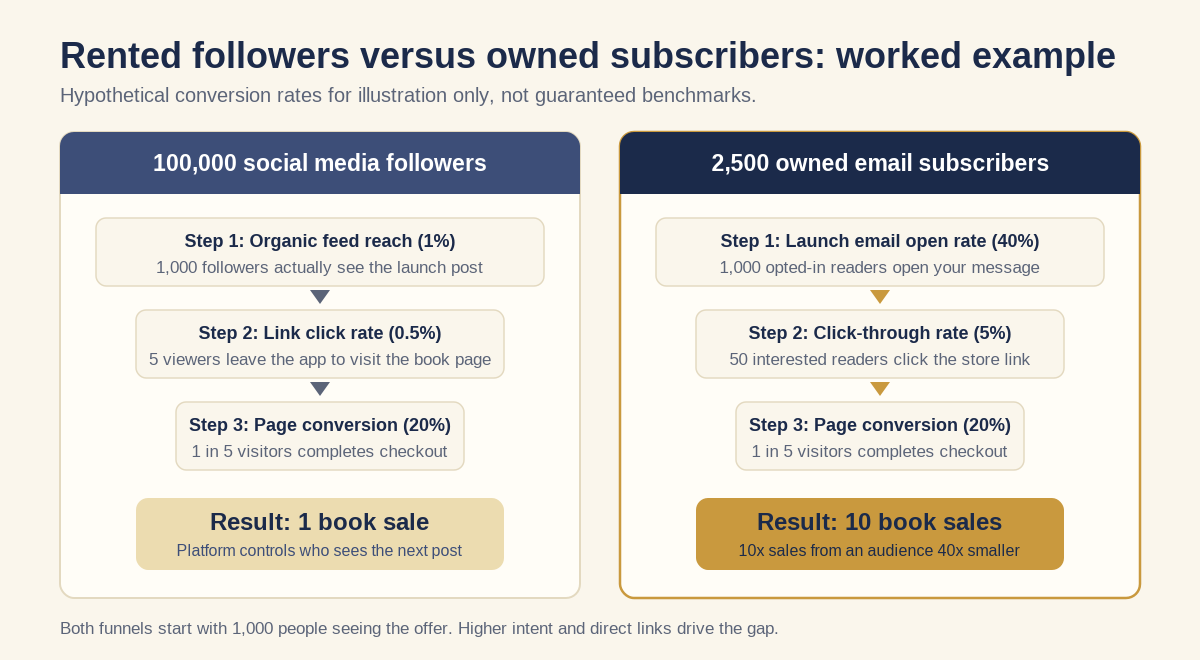
In this worked example, both authors place their launch offer in front of 1,000 eyeballs. On the social side, 100,000 followers at 1% organic reach produces 1,000 feed impressions. Because viewers are browsing passively and must navigate out through a profile link, a 0.5% click-through rate sends 5 visitors to the retail page. If 20% of those visitors buy, the 100,000-follower account generates 1 sale from that post.
On the email side, 2,500 opted-in subscribers at a 40% open rate also produces 1,000 readers viewing the message. Because subscribers chose to hear about your books and can tap a single direct link inside the email, a 5% click-through rate sends 50 warm readers to the buy page. At the exact same 20% checkout conversion rate, the 2,500-person list produces 10 sales, which is ten times the orders from an audience forty times smaller.
| Funnel stage (worked example) | 100,000 social followers | 2,500 email subscribers |
|---|---|---|
| Audience size | 100,000 followers | 2,500 subscribers |
| People who see the announcement | 1,000 (1% organic reach) | 1,000 (40% open rate) |
| Clicks to book page | 5 (0.5% click rate) | 50 (5% click rate) |
| Completed purchases (20% conversion) | 1 book sale | 10 book sales |
| Net royalty at £3.20 per ebook | £3.20 | £32.00 |
Change the hypothetical percentages and the structural gap still holds. Even if the social post reaches 3% of followers and achieves double the click rate, you are fighting platform friction on every release. Meanwhile, the email author can send a reminder to non-openers four days later, segment readers by series, and link straight to Book 2 without begging an algorithm for permission.
What survey data says about followers versus email lists
Industry research supports what the funnel arithmetic suggests. In Written Word Media's Indie Author Survey, respondents are grouped into four monthly income tiers: Just Starting Out at $500 or less a month, Building Momentum at $500 to $2,500 a month, Got Traction at $2,500 to $10,000 a month, and Living the Dream at $10,000 or more a month. Across respondents, roughly 44% report earning $100 a month or less, and over 80% name marketing as the hardest part of being an indie author.
When Written Word Media examines what separates higher-earning tiers from authors stuck at the bottom, two variables correlate most reliably with higher monthly book revenue: catalogue size and email list size. Social media follower counts show a much weaker relationship with monthly earnings. Authors with large followings often sit in the lowest revenue tier, whereas authors with modest public visibility and strong mailing lists regularly out-earn them.
Guidance published through the Alliance of Independent Authors at the ALLi Self-Publishing Advice Center points in the same direction. Sustainable indie businesses prioritise multi-book series, owned reader lists and diversified sales routes rather than chasing viral social bursts. If your sales have stalled despite posting every week, our diagnostic on why a book is not selling helps isolate whether the leak sits in your traffic, cover, blurb or price.
Comparing rented attention with an owned reader list
Calling social followers "rented" is literal rather than dramatic. You do not hold a copy of your followers' contact details, you cannot migrate them if an account is suspended by an automated moderation error, and the landlord can raise the rent at any moment by requiring paid boosts to reach the people who already asked to follow you.
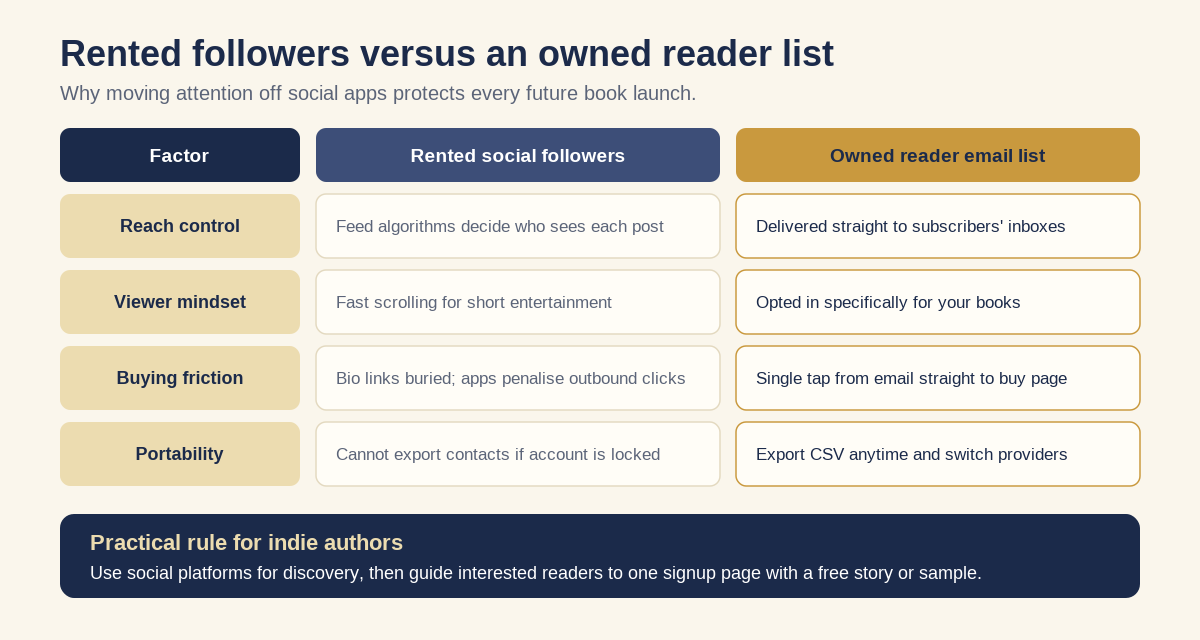
An email list behaves like a business asset. You can export your subscriber CSV whenever you like, move between email providers if pricing changes, and message readers directly on release day. As of November 2026, entry-level email services remain affordable for newer authors: MailerLite's published pricing includes a free tier for small lists with paid plans scaling by subscriber count, while dedicated author setups let you connect signup forms straight to your website.
You can see how an integrated setup handles reader signups and free book delivery on our author mailing list page. If you would rather avoid stitching separate tools together, the Indie Author Toolchest bundles an author website, mailing list, reader magnet delivery and ARC distribution for $12.99 a month or $120 a year, with a 14-day free trial requiring no card and direct ebook sales switching on when you subscribe.
How to turn social media followers into email subscribers
Rather than trying to force cold social viewers straight into a checkout, redesign your social presence around one simpler step: inviting genre-matched viewers to claim a free story or sample in exchange for an email address. Follow this six-step sequence to plug the leak.
- Audit your profile bio so a stranger understands your genre, tone and reader promise in three seconds. Replace clever slogans with a plain line such as "Cosy village mysteries set in 1920s Yorkshire."
- Remove multi-button link trees that split attention across six shops, a blog and three other social profiles. Put one primary link in your bio pointing straight to your reader magnet signup page.
- Create a genre-matched reader magnet that naturally leads into Book 1. A prequel short story, an alternate-POV bonus chapter, or a concise non-fiction starter workbook converts far better than "Sign up for author news."
- Add a short, consistent call to action at the end of roughly one in four posts. Mention the specific premise of the free story and tell viewers exactly where to find the link.
- Set up an automated welcome sequence so new subscribers receive the free file immediately, learn which paid book to read next, and hear from you again within a week. Our guide to your first six author newsletter emails gives you the full sequence.
- Track weekly subscriber additions per platform using a simple tagged link or dedicated landing page URL. After 30 days, divide your hours spent posting by new subscribers gained so you know whether the channel earns its keep.
If you are starting from zero subscribers and have no ad budget, pair that social bridge with back-matter links inside your published books and reader-magnet swaps. Our step-by-step guide to getting your first 100 email subscribers with no ad budget ranks the five sources that convert fastest for debut authors.
A realistic weekly split between social posts and list building
The hidden cost of chasing social media followers is not the software fee; it is the books you never write while filming, editing and refreshing notifications. An author with ten spare hours a week outside a day job cannot afford to spend seven of them feeding short-video algorithms.
Use a simple weekly time budget to keep social posting in proportion to its actual return. Spend at least 60% of your available hours drafting, revising or preparing your next connected book. Allocate 20% to owned-audience work: writing one reader email, refining your signup page, checking back-matter links, and tracking sales. Cap social media discovery at the final 20%, which equals two hours a week on a ten-hour schedule.
Batch three short posts in one sitting, schedule them, reply to genuine reader comments twice a week, and close the app. Judge your social account by one number at the end of each month: how many new genre-matched email subscribers clicked through and confirmed their address. Everything else is noise.
Questions, answered
How many social media followers does an indie author need to sell books consistently?
Follower count alone is a weak predictor of steady book sales because social platforms limit organic reach to a tiny slice of your audience. An author with 1,500 engaged email subscribers who read in one genre often sells more copies on launch week than an account with 50,000 casual followers.
Should self-published authors delete their social media accounts?
No, you do not need to delete active accounts if they bring genuine discovery or enjoyment. The better adjustment is to treat social media as a top-of-funnel bridge that points readers towards one signup page for your email list, rather than expecting direct checkout clicks from feed posts.
Why do social media apps hide posts that include Amazon or bookstore links?
Social media companies sell advertising based on how long users remain inside the app. When a post sends people to an external shop page, the session ends, so feed algorithms routinely give outbound-link posts lower distribution than native video or text posts.
What is the best thing to offer social media followers so they join an email list?
Offer a short, relevant reader magnet that matches the exact genre and tone of your paid books, such as a prequel novella, a bonus epilogue, or a practical checklist for non-fiction readers. Generic newsletter invitations without a clear free gift convert a far smaller share of profile visitors.
How long should an author spend on social media each week?
Cap social media at two to three hours a week unless your tracking proves it adds steady email subscribers at a sensible cost in time. Keep the majority of your working hours on drafting the next book in your series and looking after your existing reader list.