
Indie Author Academy / Lessons
How indie authors sell books to bookstores: three routes
Learn how indie authors sell books to bookstores via local consignment, direct wholesale, and IngramSpark distribution, with worked GBP and USD margins.
Indie authors sell books to bookstores through three distinct routes: local consignment, direct wholesale, and national trade distribution via IngramSpark. Each route solves a different business problem, pays a different margin per copy, and carries a different level of cash risk. Choosing the wrong route at the wrong stage can leave you paying for returned stock or pitching shops on terms they cannot accept.
The short answer for most independent writers as of November 2026 is straightforward. Use local consignment for nearby bookshops, direct wholesale for targeted gift shops or event partners, and IngramSpark when you want national ordering access through the wholesale catalogue. Before printing a single box of author copies, compare how the money moves on every path.
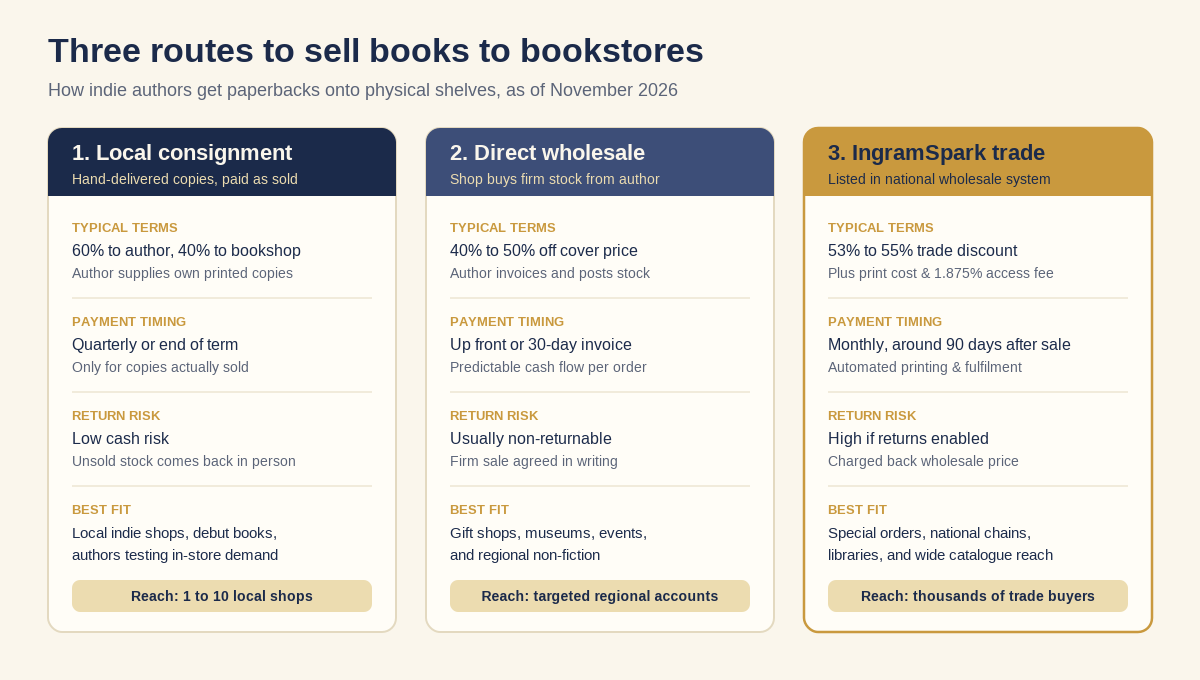
The three routes to sell books to bookstores
Physical bookshops run on tight retail margins, high rent, and limited shelf space. A shop owner cannot afford to tie up cash in slow-moving stock, and a buyer cannot spend forty minutes setting up a bespoke vendor account for two copies of one paperback. Every successful approach respects how booksellers actually buy.
Those buying habits split neatly into three practical channels. Local consignment lets a shop display copies without paying until a reader buys them. Direct wholesale lets a shop buy copies straight from you at a negotiated trade discount, cutting out any middleman. Trade distribution through IngramSpark global book distribution puts your ISBN inside the wholesale ordering system that thousands of bookshops already check every morning.
You do not have to pick one channel forever. Many authors run all three in parallel for the same paperback, provided the book carries an author-owned ISBN and clean print files. If you are still deciding how to register your book identifiers, read our guide to ISBNs for self-published authors in the UK and US, or check current pricing on the Nielsen ISBN Store UK.
Route one: local consignment agreements
Local consignment is the fastest way to see your paperback on a real shelf. You order author copies from your printer, bring three to five copies to a local independent bookshop, and sign a short written agreement. The shop displays the books for an agreed trial period, commonly 60 to 90 days.
As of November 2026, the standard indie bookstore consignment split is 60/40: 60% of the retail cover price goes to the author, and 40% stays with the shop. Terms vary from shop to shop, and some stores charge a small annual shelving or admin fee to cover bookkeeping. At the end of the agreed period, or on a quarterly settlement schedule, the shop pays you for every copy sold and hands back any unsold stock in person.
Why consignment works well for debut authors
Consignment removes the buyer's biggest objection, which is spending cash on an unproven title. Because the shop pays only after a reader buys at the till, a bookseller can say yes to a local author with minimal downside. Unsold copies simply return to your hands ready for fairs, signings, or direct orders.
Where consignment hits a ceiling
Consignment rarely scales beyond a driving radius. Tracking five copies across thirty distant shops turns into hours of admin and postage bills. Use consignment within a region you can visit in person, and check each shop's local author policy online before visiting. Many members of the Booksellers Association UK and the American Booksellers Association publish clear submission rules and preferred contact days.
Route two: direct wholesale to bookshops
Direct wholesale means the retailer buys stock directly from you on a firm sale, paying up front or on a 30-day invoice. Because no middleman sits between you and the till, typical terms run at 40% to 50% off cover price, usually non-returnable unless agreed otherwise in writing. Once the shop receives the parcel and pays your invoice, you know your exact profit with zero risk of a later chargeback.
Where direct wholesale performs best
General bookshops often prefer ordering through their main wholesaler so all titles arrive in one box. Direct wholesale fits independent gift shops, museum bookshops, tourist information centres, heritage attractions, farm shops, and specialist hobby retailers. Regional non-fiction, walking guides, local history, and bookshop launch events ordering twenty to forty signed copies also work well on direct invoice.
Paperwork to prepare for direct wholesale
Keep your paperwork crisp so a manager can process your order quickly:
- A one-page order sheet listing cover price, ISBN, unit discount, minimum order, and postage terms.
- A packing slip inside the carton showing the copy count and condition check date.
- A numbered invoice stating your business name, payment details, and due date.
- A short line confirming copies are supplied on a firm, non-returnable basis unless damaged in transit.
If you already pack orders for direct buyers, the fulfilment habits match closely. Our walkthrough on how to sell signed paperbacks direct from your website covers packaging, postage weights, and tracking.
Route three: IngramSpark trade distribution
When a reader walks into a bookshop two hundred miles away and asks the counter staff to order your paperback, the bookseller types your title or ISBN into a trade terminal. In the UK, US, Canada, and Australia, Ingram sits behind a huge share of those wholesale listings. Publishing your print edition through IngramSpark puts your book into that catalogue without holding warehouse stock yourself.
As of November 2026, IngramSpark requires a minimum US wholesale discount of 40%, while recommending a standard trade discount of 53% to 55% if you want physical bookshops to consider shelving the book. IngramSpark also applies a 1.875% market access fee on wholesale channel sales, calculated on the list price. Your publisher compensation equals the list price, minus the wholesale discount, minus the print cost, minus the 1.875% market access fee. IngramSpark has also removed its old $25 file revision fee for updates made more than 60 days after publication, which lowers the ongoing cost of fixing a typo or updating a back cover.
Why trade discount and returns sit together
A 40% wholesale discount on IngramSpark lets online retailers list your paperback and allows a bookshop to place a special customer order when a reader has already paid or committed at the counter. Most physical bookshops will still decline to order speculative shelf stock at 40%, because Ingram keeps a slice of that discount for wholesaling and leaves the shop too little margin to pay staff and rent.
Raising the discount to 55% gives the shop a standard retail margin, yet most trade buyers also look for returnability before ordering shelf copies. IngramSpark offers three return settings: No, Yes - Destroy, and Yes - Deliver. Turning returns on exposes you to chargebacks of the full wholesale price if copies do not sell, plus roughly $3 per book for US return shipping or roughly $20 per book for non-US addresses if you pick Yes - Deliver. For a full comparison of how IngramSpark sits beside Amazon print, see our lesson on IngramSpark vs KDP for indie authors.
Worked margin comparison in GBP and USD
Percentages sound abstract until you put real prices beside real print bills. The worked examples below use a hypothetical 300-page black-and-white paperback with an assumed print cost of £3.90 in the UK and $4.60 in the US. Actual print costs change with trim size, paper choice, and printer rate cards, so treat these figures as an arithmetic demonstration rather than a fixed quote. You can also test Amazon-side paperback figures with our KDP royalty calculator before setting cover prices.
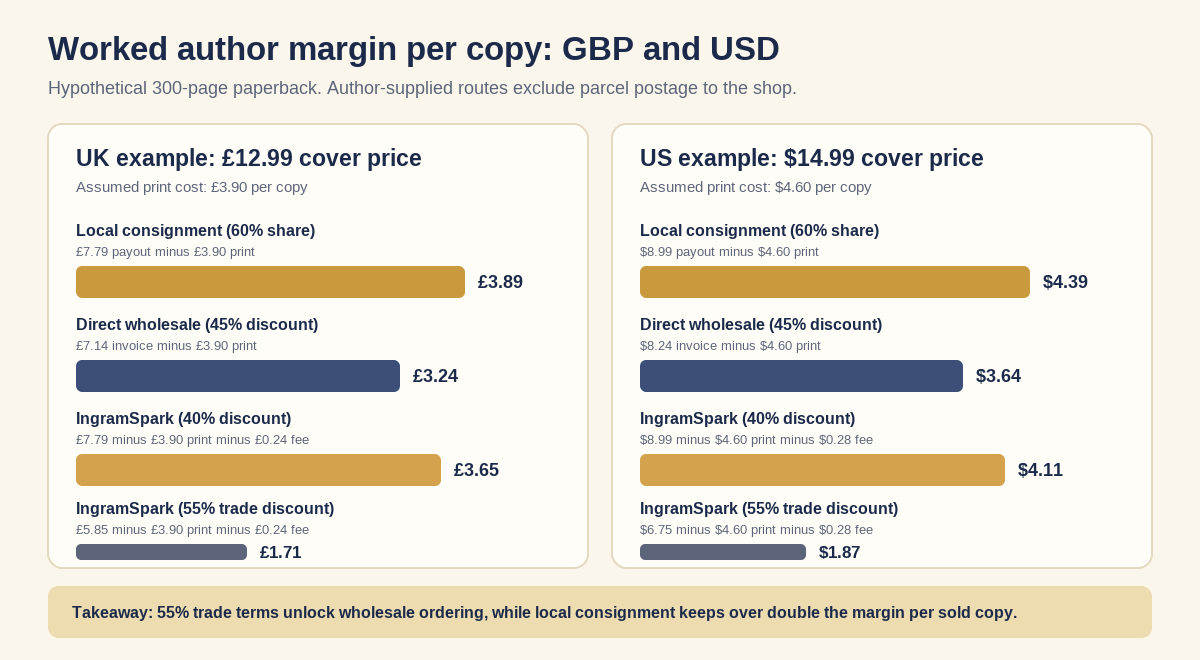
| Route and terms | UK (£12.99 cover, £3.90 print) | US ($14.99 cover, $4.60 print) | Cash risk on unsold copies |
|---|---|---|---|
| Local consignment (60/40 split) | £7.79 share minus £3.90 print = £3.89 | $8.99 share minus $4.60 print = $4.39 | Low: copies return to author for resale |
| Direct wholesale (45% discount) | £7.14 invoice minus £3.90 print = £3.24 | $8.24 invoice minus $4.60 print = $3.64 | None: firm non-returnable sale |
| IngramSpark (40% discount, 1.875% fee) | £7.79 minus £3.90 minus £0.24 = £3.65 | $8.99 minus $4.60 minus $0.28 = $4.11 | None when set to non-returnable |
| IngramSpark (55% discount, 1.875% fee) | £5.85 minus £3.90 minus £0.24 = £1.71 | $6.75 minus $4.60 minus $0.28 = $1.87 | High if returnable: charged back full wholesale price |
Look closely at the bottom row using two-decimal rounding. On a $14.99 paperback at a 55% IngramSpark trade discount, you earn $1.87 per copy after the $4.60 print bill and the $0.28 market access fee (the exact unrounded figure sits at $1.86). In the UK example at £12.99, a 55% discount leaves £1.71 per copy after the £3.90 print cost and the £0.24 market access fee.
Now compare that £1.71 or $1.87 trade profit with consignment and direct wholesale. Hand-delivering five copies to a local shop at a 60/40 consignment split pays £3.89 or $4.39 per sold book, more than double the IngramSpark 55% margin. Even if you factor in £4.00 or $5.00 in local travel or parcel postage spread across ten direct wholesale copies (adding £0.40 or $0.50 per book), direct wholesale still nets £2.84 in the UK or $3.14 in the US with zero risk of a wholesale return invoice.
Pricing also shapes whether IngramSpark trade margins survive at all. If you price that same 300-page paperback at £9.99 or $11.99, a 55% discount drops your net payout to pennies or a negative figure. Review our guide on how to price your book before locking in a retail price printed on the back cover barcode.
How to choose the right route for your book
The cleanest way to decide is to match the route to your existing reader demand and budget, rather than trying to chase national chain shelves on day one.
- Start with IngramSpark set to a 40% wholesale discount and returns switched to No if you want every bookshop and library in the country to be able to special-order your paperback safely.
- Add local consignment at three to eight nearby independent bookshops where you can build face-to-face relationships, host readings, and sign stock.
- Use direct wholesale at 40% to 50% off cover price for specialist retailers, museums, tourist shops, book clubs, and event tables that order ten or more copies at once.
- Raise your IngramSpark wholesale discount to 53% or 55% and enable returns only when you have a deliberate regional or national bookstore campaign, a dedicated marketing budget, and enough cash reserve to absorb potential return chargebacks.
Most fiction authors earn the majority of their print royalties from online retailers, direct website orders, and in-person events, with local consignment acting as community proof and a home for local launch nights. Non-fiction authors with a strong regional hook, practical handbook, or speaking calendar often generate meaningful recurring income from direct wholesale accounts.
Practical next steps before approaching a shop
Before contacting a buyer, check four basics. Verify that your paperback has a clean spine, standard trim size, and readable cover typography. Register your own ISBN so your imprint appears in trade databases instead of a free platform imprint.
Prepare a one-page sell sheet so a buyer can review your cover, blurb, ISBN, retail price, and terms at a glance; see our guide to what to include in an author press kit and our author press kit overview. Finally, inspect a physical proof copy before pitching so you know the paper weight and barcode scan cleanly at a shop till. Pick two local independent shops this week, check their local author pages online, and verify your unit print cost before quoting terms.
Questions, answered
Can a self-published author get paperbacks into physical bookshops?
Yes, self-published authors regularly place paperbacks in physical shops using local consignment, direct wholesale orders, or IngramSpark trade distribution. Each route uses different terms and carries a different level of financial risk. Most debut authors start with local consignment before turning on trade returnability.
What discount do bookshops expect from an indie author?
Through a wholesaler such as IngramSpark, physical bookshops typically expect a 53% to 55% trade discount off cover price so the wholesaler and retailer can share the margin. When you deal directly with a shop without a wholesaler in the middle, direct wholesale usually sits at 40% to 50% off cover price, and local consignment typically uses a 60% author and 40% shop split.
Do I need my own ISBN to sell paperbacks to bookshops?
Owning your own ISBN is strongly recommended because it lets you list your own imprint name and supply copies across multiple routes under one product number. Free platform ISBNs from KDP list Amazon's imprint and restrict distribution, which discourages many independent booksellers from ordering stock.
Will bookshops order my book through Amazon KDP Expanded Distribution?
Most physical bookshops avoid ordering through KDP Expanded Distribution because the wholesale terms are non-returnable and the retailer discount is too narrow for high street overheads. If you want a shop to order through its usual wholesale catalogue, IngramSpark is the standard print-on-demand path.
Should I offer consignment or wholesale to my local independent bookshop?
Ask the shop for its local author policy before pitching terms, because many independent bookshops have a standard consignment form ready to sign. Consignment removes upfront inventory risk for the bookseller, which makes a first shelf placement much easier to secure than a firm wholesale purchase.